

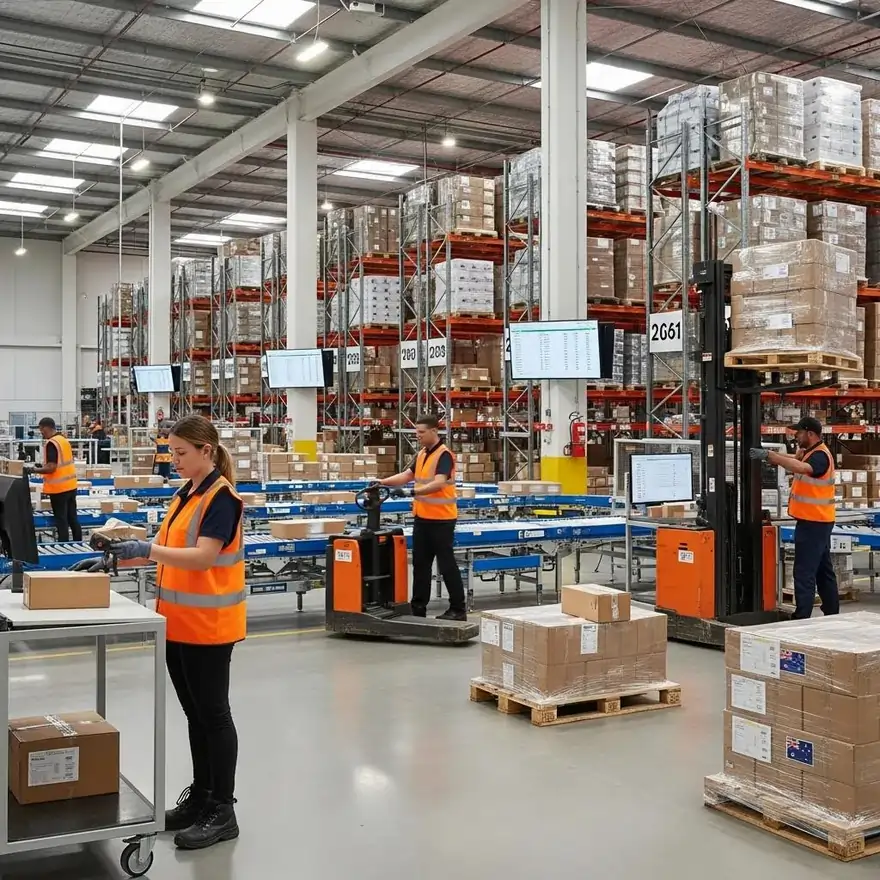
Reliable 3PL Solutions Australia: What Makes Our Third-Party Logistics Services Dependable?
Reliable third‑party logistics (3PL) means predictable, measurable performance across storage, handling, and distribution, the kind that lowers operational risk and helps you keep customer promises. In practical terms, reliability comes from accurate inventory control, consistent lead times, and clear visibility so businesses can match supply to demand and protect their brand. This page outlines what reliability looks like for supply chains in Australia, how it’s measured, and which operational practices and technologies deliver dependable results for e‑commerce, B2B distribution, and project cargo. We also highlight regional considerations for Sydney and Queensland and show how structured processes reduce stockouts, speed fulfilment and cut damage rates.
The sections that follow map directly to the decisions procurement and operations teams face. We start by defining reliability and listing the KPIs that prove it. Then we explain how a 3PL embeds those pillars in everyday operations and what to look for when choosing a partner. Next we cover the technologies, WMS, tracking, and automation that improve accuracy and throughput, before focusing on the people and quality systems that sustain consistency. Finally, we describe specialised services like e‑commerce fulfilment, container unpacking, and project logistics that remove common failure points. Keywords such as reliable supply chain management Australia,” “reliable 3PL partner Australia and secure warehousing solutions Australia are used naturally to support discovery and context.
What Defines Reliability in Third-Party Logistics Services?
Reliability in third‑party logistics is the repeatable delivery of the right product, in the right condition, to the right place, at the right time, achieved through standardised processes and measurable controls. Standard operating procedures, technology‑enabled visibility, and clear service‑level agreements (SLAs) reduce variation and enable proactive exception handling. The payoff is lower inventory risk, higher customer satisfaction, and measurable KPIs such as on‑time delivery and inventory accuracy. Knowing these basics helps businesses pick partners who can handle everyday demand and peak periods while keeping costs and risk in check.
Dependable 3PL performance shows up in measurable indicators and is driven by concrete practices like cycle counting, slotting optimisation and contingency planning. Here are the core pillars you should expect from a reliable provider.
Accuracy: Inventory controls and cycle counts that keep stock records aligned with physical inventory.
Timeliness: Predictable lead times and on‑time deliveries backed by SLAs and contingency routing.
Visibility: Real‑time tracking and reporting that highlight exceptions early for fast remediation.
Security: Secure warehousing and handling procedures that reduce theft and damage.
Flexibility & Scalability: The ability to scale capacity and adapt processes when demand shifts.
Each pillar connects to KPIs, inventory accuracy, on‑time delivery, and order accuracy rate that procurement teams can monitor to confirm performance and drive continuous improvement. The next section explains how supply chain reliability affects business outcomes, especially for e‑commerce and B2B operations.
Academic and industry research reinforces the value of structured models and KPIs when assessing third‑party logistics performance.
Measuring 3PL Performance with SCOR Model & KPIs
Purpose: This paper examines how the Supply Chain Operations Reference (SCOR) model applies to service‑oriented providers and identifies the key performance indicators relevant to third‑party logistics.
Supply chain performance measurement for third-party logistics, D Jothimani, 2014
At Pat Express Pty Ltd we define reliability through those same pillars and focus on practical outcomes: strategic partnerships, tailored solutions, and seamless execution. We emphasise efficiency and cost control in services such as container unpacking, supported by a regional footprint in Sydney and Queensland, all of which shorten lead times and reduce damage risk. This framing shows how abstract reliability principles turn into concrete services and regional capabilities that benefit clients.
What Are the Key Pillars of Reliable 3PL Solutions?
Reliability is built on operational pillars that turn policy into repeatable action: accuracy, timeliness, visibility, security, and scalability. Accuracy comes from regular cycle counts, barcode‑guided pick‑and‑pack, and reconciliations. Timeliness relies on agreed SLAs, smart carrier selection, and contingency routing. Visibility depends on integrated data flows and dashboards that surface exceptions and provide ETAs. Security includes controlled access, physical safeguards, and validated inbound checks. Scalability is achieved through flexible staffing models and regional warehouse capacity to absorb peaks.
Accuracy: Cycle counts and WMS‑guided picking that limit inventory variance and improve order accuracy.
Timeliness: SLAs and contingency plans that preserve on‑time delivery during disruption.
Visibility: Real‑time tracking systems that provide ETAs and exception alerts for proactive management.
Executing well across these pillars lowers returns, short‑ships, and customer complaints. The next subsection shows how these pillars translate into measurable business impact.
How Does Supply Chain Reliability Impact Business Success?
Reliable supply chains boost customer satisfaction, protect revenue, and cut operating costs by reducing stockouts, returns, and emergency freight. For e‑commerce retailers, dependable fulfilment increases conversion and repeat purchases because customers receive accurate, on‑time orders with clear tracking. For B2B buyers, better forecasting and inventory accuracy free up working capital and enable leaner procurement. During peak seasons, reliable logistics reduce the need for costly last‑minute shipments and provide the predictable lead times marketers and project teams depend on.
Reduced stockouts: Fewer lost sales and improved customer retention.
Fewer returns: Lower reverse‑logistics costs and higher order accuracy.
Operational resilience: Faster recovery from disruptions through contingency planning.
Even small gains in inventory accuracy tighten replenishment cycles and lower safety stock, freeing cash and improving service levels. That causal chain explains why investing in reliable 3PL capability delivers organisation‑wide benefits.
How Does Pat Express Ensure Reliable Third-Party Logistics in Australia?
Reliability comes from documented processes, regional infrastructure, and continuous measurement aligned to client goals. PAT Express combines warehousing in Sydney and Queensland with tailored workflows, trained teams, and SLA‑driven monitoring. We map client requirements to specific operational steps, order integration, inbound inspection, slotting, and scheduled distribution runs, so results are repeatable and measurable. Our service mix includes Third‑Party Logistics (3PL), Project Logistics, Container Unpacking, and Commercial Furniture Installation, each delivered with transparent performance metrics.
Set clear SLAs and KPIs: On‑time delivery, order accuracy, and inventory variance targets.
Maintain regional presence: Sydney and Queensland warehouses to reduce lead times and risk.
Integrate systems and reporting: Shared dashboards and regular reviews to keep everyone aligned.
We position Pat Express as a strategic partner delivering tailored, seamless solutions and service design rather than one‑size‑fits‑all execution, which provides reliable outcomes across diverse SKU mixes and volumes.
What Tailored Solutions Does Pat Express Offer for Unique Business Needs?
Tailoring begins with analysing SKU profiles, volume patterns and delivery expectations, then designing pick‑and‑pack methods, storage rules and reporting to match those needs. For e‑commerce customers that means optimised pick flows, returns handling and shopping‑cart integrations; for project logistics it means staged planning, equipment allocation and site coordination. Custom storage plans handle seasonality and promotional spikes through reserved space and pre‑staging. The outcome is a bespoke mix of space, labour and systems that aligns cost with service expectations.
E‑commerce fulfilment: Automated pick lists and returns workflows that protect order accuracy.
Project logistics: Detailed staging and scheduling to meet installation windows.
Custom storage: Seasonal capacity planning and pre‑staging for promotional peaks.
These modules let us scale service intensity up or down while keeping core reliability metrics within agreed tolerances, reducing operational surprises for clients.
How Does Pat Express Act as a Strategic Partner in Logistics Operations?
Being a strategic partner means regular performance reviews, joint forecasting, and shared continuous‑improvement cycles that align logistics with commercial goals. PAT Express provides dedicated account management, KPI dashboards and scheduled operational reviews to surface opportunities and implement corrective actions. Joint forecasting and inventory planning reduce emergency freight and enable smoother seasonal transitions. Our partnership model values transparency, shared metrics and open communication, so trust is built on verifiable performance gains.
Dedicated account management and reporting to sustain performance.
Joint forecasting and inventory planning to match supply with demand.
Operational reviews and continuous improvement cycles for steady gains.
This collaborative approach turns logistics from a transactional cost into an operational lever that supports growth and controls spending.
Which Technologies and Infrastructure Support Our Reliable 3PL Services?
Dependable 3PL services rest on an integrated technology stack and regional physical infrastructure that together reduce errors, speed throughput, and give stakeholders visibility. Core systems include a warehouse management system (WMS) for inventory control and tasking, real‑time shipment tracking for exceptions, and integrations with e‑commerce and order‑management platforms for smooth order flow. Warehouses in Sydney and Queensland shorten east‑coast transit times and provide redundancy during disruption. Automation and data‑driven slotting lower manual errors and cycle times, while analytics reveal improvement opportunities.
WMS: Centralised inventory control and guided workflows that cut picking errors.
Real‑time tracking: ETA updates and exception alerts that support proactive communications.
Integrations & automation: Order routing and carrier connections that speed fulfilment.
The table below compares core technologies by role and the KPIs they typically improve, to help you prioritise investments for reliability.
Different technologies close different reliability gaps and link directly to measurable KPIs.
| Technology | Functionality | Typical KPI |
| Warehouse Management System (WMS) | Inventory tracking, guided picking, cycle count scheduling | Inventory accuracy (%) |
| Real-Time Tracking Systems | Shipment visibility, ETA updates, exception alerts | On-time delivery rate (%) |
| Automation & Robotics | Picking/packing automation, conveyor tasking | Throughput (orders/hr) |
This comparison shows how each technology targets a particular reliability gap; the right mix depends on volume, SKU complexity, and client SLAs. The next section explains how advanced WMS features specifically enhance reliability.
How Do Advanced Warehouse Management Systems Enhance Reliability?
An advanced WMS improves reliability by delivering inventory visibility, automating task allocation and enforcing process rules like pick sequencing and packing checks. Slotting optimisation reduces travel time and errors, while embedded cycle‑count routines keep inventory variance low. Integration with order and carrier systems automates label generation and bookings, cutting manual handoffs that create mistakes. These capabilities yield measurable gains, higher-order accuracy, and shorter fulfilment cycles, which boost customer satisfaction and lower reverse‑logistics costs.
Optimising warehouse operations, especially through smart slotting, is a proven way to lift 3PL performance and reduce costs.
Warehouse Slotting Optimisation for 3PL Performance
Purpose: Slotting is a core warehouse activity focused on efficient allocation of slots to SKUs. Because order picking and slotting account for a large share of logistics costs, improving these areas delivers meaningful performance and cost savings.
Warehouse management optimisation using a sorting-based slotting approach, JM Cogollo-Flórez, 2024
Inventory visibility and automated tasking reduce manual mistakes.
Guided workflows enforce packing and labelling standards for consistency.
Integration with order and carrier systems shortens fulfilment cycles.
Effective WMS deployment combines configuration, process redesign and operator training to secure lasting reliability gains.
What Role Does Real-Time Tracking Play in Supply Chain Visibility?
Real-time tracking turns reactive firefighting into proactive management by providing live ETAs, exception alerts, and a historical trail for root-cause analysis. Automated notifications for delays or anomalies give account teams time to activate contingency plans, rerouting carriers or reallocating stock, before customer experience suffers. Dashboards that aggregate KPIs help procurement and operations forecast capacity needs and spot recurring issues. For customers, access to tracking builds trust and reduces inbound enquiries, freeing operations to focus on resolution.
Proactive exception handling via automated alerts.
Better forecasting and ETA accuracy using historical tracking data.
Greater transparency for customers, reducing enquiry volume and disputes.
Linking tracking to SLAs and escalation paths closes the loop between visibility and operational action, preserving reliability even when things go wrong.
Who Are the Experts Behind Our Reliable Third-Party Logistics Solutions?
Reliable logistics depend on people as much as systems: experienced planners, operations managers, and quality teams who turn processes into dependable outcomes. Our teams blend operational know‑how with specialist skills like project cargo planning, e‑commerce fulfilment design and container unpacking. Training, performance coaching and role‑based competencies ensure staff follow processes and escalate issues correctly. Human judgement fills the gaps automation can’t handle and drives continuous improvement.
Operations managers who optimise throughput and balance labour.
Project logistics planners who coordinate complex cargo and timelines.
Quality and account teams that keep clients informed and SLAs on track.
These people, backed by clear processes and fit‑for‑purpose technology, are the backbone of steady 3PL performance and ongoing reliability improvements.
What Experience Do Our Logistics Professionals Bring?
Our logistics professionals bring hands‑on experience across operations management, project logistics and e‑commerce fulfilment, equipping them to manage SKU complexity and fluctuating demand. Operations leaders focus on throughput, safety, and continual improvement; project planners handle staging, lifting plans, and site coordination; customer‑facing staff manage SLAs, reporting, and exceptions so clients get timely, accurate information. That role diversity speeds issue resolution and preserves execution quality.
Operations management experience for throughput optimisation and labour planning.
Project logistics expertise for complex shipments and installation coordination.
Customer service and account management for clear client communications.
That mix of skills helps teams stabilise operations quickly when volumes change or new projects begin, keeping reliability intact under pressure.
How Do Quality Control and Risk Mitigation Ensure Consistency?
Quality control and risk mitigation are built into inbound inspections, cycle counts, packing checks, and documented escalation flows that stop small errors from becoming systemic. Regular audits and KPI monitoring reveal trends like repeated damage or picking mistakes, prompting retraining or process redesign. Risk registers and contingency plans, backup carriers, alternate storage sites, and insurance reduce service interruptions. SLA monitoring and root‑cause correction drive continuous improvement.
Inbound QC, cycle counts, and packing checks to catch errors early.
Risk registers and contingency plans for carrier or site disruptions.
SLA monitoring with corrective actions to sustain performance.
Combining preventative checks with contingency planning lowers the likelihood and impact of failures, preserving consistent operational outcomes.
What Specialised Services Enhance the Reliability of Our 3PL Solutions?
Specialised services remove common failure points by treating complex tasks as standard workflows rather than exceptions. E‑commerce fulfilment uses integrated order flows, packaging standards, and returns handling to protect order accuracy and customer experience. Container unpacking accelerates inventory availability by staging shipments, reconciling contents immediately, and logging damages at the point of unpacking. Project logistics applies detailed scheduling, equipment allocation and site coordination to avoid delays and cost overruns. Each specialist service targets typical disruption sources and converts them into controlled, auditable processes.
E‑commerce fulfilment: Structured pick/pack and returns processes that protect order accuracy.
Container unpacking: Fast reconciliation and damage control to cut dwell time.
Project logistics: End‑to‑end coordination that aligns deliveries with installation schedules.
These services are especially valuable for organisations with high SKU counts, frequent promotions or complex project needs because they reduce manual error and speed time‑to‑availability.
The following table compares key specialised services by scope, lead time, and typical clients to help guide your choice.
| Service | Scope | Typical Clients |
| E-commerce fulfilment | Order processing, packing, returns management | Online retailers, subscription services |
| Container unpacking | Unloading, staging, immediate reconciliation | Importers, high-volume retailers |
| Project logistics | Planning, staging, site coordination | Construction, events, commercial installations |
How Does E-commerce Fulfilment Ensure Consistent Deliveries?
Consistent e‑commerce fulfilment depends on integrated order capture, automated pick lists, and standard packaging protocols that reduce errors and speed handling. Shopping‑cart and order‑management integrations automate order routing, while guided picking and barcode validation ensure the correct items are packed. Returns and reverse‑logistics workflows are built in so returned stock is processed, quarantined, or restocked promptly. KPIs such as order accuracy, on‑time dispatch, and returns turnaround track performance.
Integrated order flows and automated pick lists to remove manual steps.
Packaging and labelling standards to speed carrier handoffs and reduce damage.
Returns processing and reverse logistics to minimise inventory downtime.
These practices improve customer experience and cut the cost of fulfilment errors, especially during promotional peaks.
What Makes Our Container Unpacking and Project Logistics Efficient?
Efficient container unpacking reduces dwell time by staging loads, reconciling inventory immediately, and reporting damage at unpack. That shortens time‑to‑availability for imported goods and prevents damaged items from entering inventory unnoticed. Project logistics brings the same discipline, detailed staging plans, site access coordination, and delivery windows aligned with installation teams. Together, these services prevent delays and overspending caused by poor coordination or late damage discovery.
Staged unpacking and immediate inventory reconciliation to cut dwell time.
Damage reporting and quarantine procedures to protect inventory accuracy.
Coordinated project scheduling to align deliveries with installation and site readiness.
Those operational steps turn potentially chaotic import and project activities into controlled processes, materially reducing the risks that undermine reliability.
PAT Express focuses on tailored, seamless service design that integrates Third‑Party Logistics (3PL), Project Logistics, Container Unpacking, and Commercial Furniture Installation into client workflows to reduce risk and cost. Strategic partnership, customised solutions and a clear regional presence in Sydney and Queensland support consistent supply chain outcomes. When evaluating 3PL partners, prioritise demonstrable KPIs, specialised service modules, and transparent reporting that enables collaborative improvement.
Conclusion
Choosing a reliable third‑party logistics partner can materially improve your supply chain, delivering on‑time shipments, accurate inventory, and fewer surprises. By prioritising pillars like accuracy, visibility, and tailored solutions, organisations can cut risk and lift customer satisfaction. If you’d like to see how our specialised services could streamline your operations and deliver measurable results, get in touch; we will help you find the right solution for your business.